Pages

Showing posts with label Entering the Catholic Church. Show all posts

Thursday, July 26, 2012

The Way is Shut

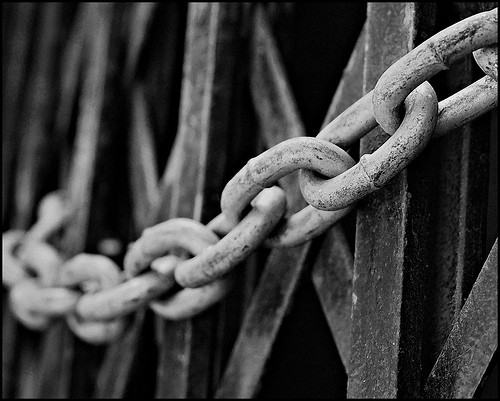
“The way is shut. It was made by those who are dead, and the dead keep it. The way is shut."

--J.R.R. Tolkien, The Lord of the Rings
Some days I think I know where I'm going:  the path before me seems to unfold almost miraculously and I explain to myself that I'd be a fool not to see the hand of God in all the twists and turns and coincidences that are too coincidental to be coincidences.  Some days it seems that the heavens open up and God drops a neon arrow in my path that says, very clearly, "This way, please."

And then there are days like today, nights like tonight.  Days when I cannot see the path no matter how I squint; nights when I'm not even sure I'm in the remote vicinity of a path but fear that I've instead wandered off into the briars and the tangles.  Nights when I stumble blindly on, hands outstretched, only to bump into the cold steel of a chained gate.

Let me back up:  for two years I've seen the way before me open up in miraculous ways and I've come to believe that God is leading me to the Catholic Church.  This makes many of my non-Catholic friends roll their eyes, huff a little, and probably click off this blog and navigate to something that makes them less angry or frustrated.  Yet, while I know this personal journey of mine has been publicized (by me) far too loudly and far too often, it's only because it's hard to constrain the joy and excitement and terror I feel as I watch God's hand move in my life.  

This moving is more clear to me than anything else I've ever experienced.  It's not quantifiable, provable, or even visible.  Instead, it's everything a journey of faith should be:  terrifying, dangerous, seemingly insane, full of promise.  In fact, I feel like a miniature, much less epic, version of Abraham.  It's almost as if I've heard this booming voice saying "get up and go to this crazy land of incense and genuflections and statues and 1 million other weird and unusual things."  (To be clear--and in the interest of full disclosure--I've heard no such voice:  it's just a leading that I can't explain any other way.)

And, moving on, I'm trying to be obedient to that leading, but it's not easy:  The Catholic World, after all, is profoundly different from anything this American Protestant has ever experienced.  And yet, over time, as I've come to better understand the weird things, the unusual things, the seemingly unexplainable things, I've begun to find something I never thought I'd find:  true faith and, even more importantly, a a deeper, more personal relationship with Christ than I've ever experienced.

God has clearly been a part of this journey.  His fingerprints are all over it.

But, there's a problem--a problem that clouds everything and brings me back to the darker beginning to this entry:  my wife is neither so inclined, nor so excited, nor so happy.  Her Catholic journey, in fact, seems destined to be much, much shorter than mine.  Whereas I've been drawn to the Catholic Church, she's drawn back to our previous life of Protestantism.  We are both heading in opposite directions and neither one sees how it's possible to reverse our path and go the other's way.

And that's tough to deal with because I know that my journey--as exciting as it is for me--is breaking her heart.  She doesn't want to come with me and yet, neither does she want our family to attend different churches.

Which brings me to the next big complication:  our kids.  All five of them.  What will we do with them?  Do we let them decide on their own? (Many folks on both sides say that's the right thing to do--but I will not simply turn two 11 year-olds, an 8 year-old, a 7 year-old and a 4 year-old loose in the world of theology, suggesting that they "choose for themselves."  That day will come.  But now, I, as a parent, must train.  Yes, it's politically incorrect, yes, it's old school...but you will not change my mind.  It's my responsibility as a father.) 

So, I can let them choose on their own (which I can't do--not at this age), or we could raise them in both churches and confuse them beyond words.

For me, that's not an option either, because I don't just "like" Catholicism better than Protestantism.  It's not about music or styles of worship or the cool little donuts they serve after Mass.  I'm moving toward Catholicism simply because I believe it's the Truth. (And I know this makes my Protestant friends family members angry, but it really shouldn't.  To hopefully defuse any anger, let me ask a question:  why do you remain Protestant?  Why don't you go to the Catholic Church instead from time to time?  The most basic answer is because you don't believe it to be true.  You think, instead, that Protestantism is true and so you stay there.  I on the other hand, believe Catholicism to be True and must go there.  So don't be angry when I say I think Catholicism is true.  I'd be a fool to pursue something this disruptive to my life if I didn't fully believe it to be the truth.)

Anyway, I want to raise my kids Catholic because I believe it's the Truth.   My wife, on the other hand, has different ideas.  Hence the confusion.  Hence the clouded path.  Hence the darkness.  

As a couple, we are at a loss.  We're not angry with each other, we're not dueling.  We're getting along as well as we ever have.  But there's a sadness and a confusion that hangs over everything.

What do I do?  As a father, do I lead even where my family doesn't want to go?  Or do  I step back and let them lead?  Or, do we just "agree to disagree" and each go our own separate ways in regards to our faiths?  And how does that play out for the kids, for us?

The good news is that as dark as this all is . . . it's God's plan.  And when we follow the path to its natural end, we'll be thankful for the journey.  The suffering along the way has value and, when we arrive at journey's end, we'll rejoice in the land He's brought us to. 

But that's somewhere down the road.  First, we've got to get there.  And that means walking.  And right now, we're not sure where to put the next foot. For right now, we're lost.  Tonight we're looking for a path.  We're looking for a way.  The Way. 

But it's shut. 

Wednesday, July 4, 2012

Some Things Don't Change: John Adams Describes a Catholic Mass

It's funny how some things just don't change.  For example, here's a quote from John Adams of Founding Fathers fame.  It's taken from a letter he wrote to his wife, Abigail after he attended a Mass at St. Mary's Catholic Church in Philadelphia with George Washington on October 9, 1774:

This afternoon, led by Curiosity and good Company I strolled away to Mother Church, or rather Grandmother Church, I mean the Romish Chapel.  Heard a good, short, moral Essay upon the Duty of Parents to their Children, founded in justice and Charity, to take care of their Interests temporal and spiritual.  This afternoon's entertainment was to me most awful and affecting.  The poor wretches fingering their beads, chanting Latin, not a word of which they understood, their Pater Nosters and Ave Marias.  Their holy water--their crossing themselves perpetually--their bowing to the name of Jesus wherever they hear it--their bowings, and kneelings, and genuflections before the altar.  The dress of the priest was rich with lace--his pulpit was velvet and gold.  The altar piece was very rich--little images and crucifixes about--wax candles lighted up.  But how shall I describe the picture of our Saviour in a frame of marble over the altar, at full length, upon the cross in the agonies, and the blood dropping and streaming from his wounds.

The music consisting of an organ, and a Choir of singers, went all the afternoon, excepting sermon Time, and the Assembly chanted--most sweetly and exquisitely.  Here is everything which can lay hold of the eye, ear, and imagination.  Everything which can charm and bewitch the simple and the ignorant.  I wonder how Luther ever broke the spell.

So, the things that don't change?

First, the Mass.  The Mass doesn't change.  Here we have an eye witness account of a Mass from 1774.  And every single detail is what we'd see at Mass today, excepting (possibly) some of the Latin.  The crucifixes are still there.  So are the candles.  And the gold and the marble.  The altar is still front and center and the images of Christ are just as bloody.  The beads are still there, the "Pater Nosters" (The Our Fathers) and the "Ave Marias" (The Hail Mary's) are still quietly mumbled by reverent (and not always so reverent) worshippers.  Holy water, the sign of the cross, the bowing and the genuflections . . . all still there.   The Mass hasn't changed.

The second thing that hasn't changed since the letter was written?  A latent distrust, dislike, disapproval, misunderstanding and overall prejudice against all things Catholic.  Adam's mood and attitude was typical of the Colonists at that time period.  And sadly, it's quite representative of the attitudes today.  

Now, don't get me wrong:  I'm a big John Adam's fan and don't fault him (necessarily) for maintaining and espousing the attitude of the day.  I understand that the colonies at that point in time were decidedly unfriendly to the Catholic faith and he was, as are we all, a product of his times.  

Still, I wonder that he didn't realize his inability to declare, after attending just this one Mass, that the people chanting and praying in Latin understood "not a word"?  I wonder at the intellectual elitism by which he reduced people with different thoughts and traditions than him to "poor wretches" who are easily charmed and bewitched--the "simple and the ignorant".   I wonder at his inability to put words to the sight of the Savior doing the work of saving.  He sees Jesus "in the agonies", not cleaned up with flowing hair and winning smile after the resurrection, and he simply says "how shall I describe [Him]?"

All in all, Adam's words reflect an anti-Catholicism that's all too common:  complaints that are lodged based largely upon misunderstandings, hasty judgments, and a sense of superiority--both religious and intellectual.  And yet, it's difficult to read his letter without picking up on some threads of thought that suggest that while he is disposed to hate the Mass . . . he still finds parts of it intriguing, compelling, "bewitching".  He writes of a beauty in the chant that's "sweet" and "exquisite".

He writes that everything about the Mass appeals to every part of who we are as people:  "Here is everything which can lay hold of the eye, ear, and imagination."   And he's right:  In the Mass, our eyes take in the beauty and majesty, the cross, and the One on the cross.  Our ears soak up the chants, the bells and the high language and we're aware that we are not just "anywhere"--we are in a Holy and otherworldy place.  Our sense of smell picks up on the incense.  Our sense of touch is brought into worship when we dip our fingers in holy water and cross ourselves, remembering our baptism, the Trinity, and the miracle of forgiven sins.  And finally, at the pinnacle of the Mass, we taste and eat the Body and Blood of the Lord in Holy Communion.  

All of these sights and sounds, smells and bells, work together to stir our imagination and conjure the deep thoughts of our souls.  Adam's doesn't embrace it fully--in fact, he basically tries to poke at it gently from a very long ways away--but he still sees that it's there:  a draw, a beauty.

I found the same things in my journey to the Catholic Church.  I began two years ago with the sentiment Adams seems to convey in the letter:  I pitied Catholics for their empty, shallow and self-reliant faith.  I despised the beads, the holy water, the vestments, the gold, the marble.  I saw all of these as fetters holding them back from true faith.  But still, alongside the dislike--the dislike I knew I should feel--I found something else beginning to grow:  a growing appreciation of the reverence.  Of the Altar.  Of the Crucifixes.  Of the Genuflecting and the bowing and the silence.  Of the Holy Water and the candles and even, finally, an appreciation of the beads and the statues and the icons.

I slowly began to see and learn that not one of these items or practices is without symbolic meaning--deep, ancient and rich.  And when I dug beyond appearances and past prejudices and actually explored that meaning, I found--where I least expected to find Him--Christ.

We genuflect, because Christ is truly, physically here, at every Mass.  We cross ourselves with Holy Water and pause because we're recalling our baptism and the washing of our sins.  The altar is where the once-for-all sacrifice of Christ is re-presented. The crucifix reminds us of the Price--the Price God was willing to pay (and did pay) to redeem the entire world.  And above all, before all, at the center of all, is Our Lord in the Eucharist, Body and Blood, Soul and Divinity.  The same as He was 230+ years ago when Adams strolled into a Catholic Church with George Washington.  And the same as He was roughly 2000 years ago when spoke to His apostles on the night before His passion and said "This is my body..."  

Thank God some things never change....

Sunday, April 15, 2012

A Far Green Country Under a Swift Sunrise

As [my wife] and I struggled and talked and prayed all through that autumn of 1984, the tug-of-war inside of me was between "Am I mad?" and "Show me, dear Christ, Thy spouse so bright and clear."  Could I introduce this fissure into our very household?  How could I possibly head for a Table other than the one at which my dear lady made her communion from week to week, and at which I had brought up my children, and, indeed, at which I myself had worshipped for twenty-five years?
--Thomas Howard, Lead, Kindly Light (p. 64-65 )

So writes Thomas Howard, an Anglican convert to Catholicism, about his journey to Rome.  And I find myself echoing his thoughts, though certainly not his prose, as I weigh the same decision and mull the same looming consequences:  what will happen to my children if I pull up stakes and head for that strange and ancient country?  What about my wife?  

My dream was always to be a father and to live in a comfortable little house and close enough to a small Baptist or Reformed church that we could walk there on crisp, sunny Sunday mornings.  That's what I pictured, what I wanted.  And that's what I have:  a thriving church filled with kind, friendly and real people.  

My children are happy there.  My wife is happy there.  And I was happy there until a couple of years ago when I found myself suddenly face to face with the authentic Catholic Church. (I say "authentic" because as Archbishop Fulton Sheen once accurately wrote "There are not a hundred people in America who hate the Catholic Church. There are millions of people who hate what they wrongly believe to be the Catholic Church — which is, of course, quite a different thing.")

That certainly summed up my experience.  I had always pitied the Catholic Church and the poor Catholics with their mumbled Hail Mary's, their rote prayers, and dry, dead faith.   I knew from vast amounts of experience (which I gained by listening to various preachers talk about Catholics) that Catholic Churches were places of despair where the misinformed throng was taught to "earn their way to heaven", to "bow in worship to Mary" and to completely ignore the saving work of Jesus, replacing the "real" Christ with a sissy who was bossed around by his mother.  (I remember an ex-Catholic in one of the churches I attended explaining that the "Catholic Jesus" he'd been raised to believe in was a "namby-pamby Jesus."  And that he was glad to finally have found the "real Jesus" here.)

So, when I looked into the claims of the Catholic Church--mostly just to disprove them with my tremendous Biblical knowledge (of which I was humbly proud)--I began my search with no fear at all of being converted.  In fact, I began my study with no fear at all that it would even develop into something that could accurately be described as a "study".  I figured it would be an afternoon (maybe two) of reading and then I figured I'd step in with my great wisdom, derail the Catholic arguments easily and handily, and be back home in time for dinner.

But it didn't go that way.  Instead of finding the Catholic Church I'd always heard about, I found something all together different.  Something ancient and yet vibrant.  Something tied indelibly to history and yet current and, to use a sadly overused and twisted word, relevant.  To put it simply:  I found Christ.  And not the "namby-pamby" Christ that my ex-Catholic friend had warned me about.  I found a blood-and-bones Jesus who loved and suffered and died and rose.  In short, I found the same Jesus I'd always known about--and yet I found him in what seemed the most unlikely of all places.

Still, this didn't completely sway me.  I remember thinking that this was good news (I have a number of Catholic friends and it was a great surprise and comfort to discover that they may indeed be "saved" after all and that I needn't worry about them as much as I had been) but I still believed them to have a faith full of errors and misguided devotions.  

However, that initially startling discovery of Christ in the Catholic Church did lead me to dig a little deeper:  after all, there was no fear of my conversion to Catholicism, so I might as well try to understand their strange ways a little better.

And so I've done for the last 2 1/2 years or so.  I've read books by Protestant converts, countless conversion stories and basic introductions to the faith.  When those made more sense than I thought possible, I looked to Protestant sources to refute this belief system and get me back on track.  However, instead of finding reasoned arguments against Catholicism, what I found was sad, angry and vitriolic.  Even with my limited study, I was able to see that many of the arguments presented by "ex-Catholics who left the Church when they found Jesus" were simply not based in fact or in a firm understanding of their previous Catholic faith.  In some cases, I found what I can only believe were lies (supposed ex-Catholic priests with a poorer understanding of the Eucharistic mysteries than I myself had after reading just a few books or researching for more than 10 minutes on the internet).

Neither confirmed nor comforted by my Protestant compatriots, I went back to Catholic sources to see what they had to say about themselves.  I picked up the Catechism, dipped into the writings of various Saints and looked into the documents written by the early Church Fathers.  After that, it was time to tackle Conciliar documents and encyclicals.  All of these were rooted in Scripture and the writers, rather than having a disdain for the Word of God (as I'd been taught) actually held the Bible in high regard.

By the end of all this--or actually, part way through--I discovered that something had shifted in my thinking:  instead of reading to disprove their doctrines, I was reading to understand them better.  At some point in the journey, I'd come to the very remarkable (in my opinion) point that whenever a Catholic Doctrine or Teaching seemed bizarre and unnatural and pagan and unholy, it's very likely that I simply didn't understand it. (Afterall, when I read the love for Christ that is apparent in the writings of the Church's Saints and Doctors, who am I to so quickly and easily conclude (with my immeasurable storehouse of Biblical Knowledge) that I had succeeded where they had failed?  That Saint Thomas Aquinas, or Saint Augustine, or Saint Louis de Montfort failed to discern true Christianity whereas I, Daniel Hansen of Zeeland, Michigan, was able to grasp the fruit the giants couldn't reach?  To make that claim is a failure to think critically and honestly on my part.  Or at the very least, it gives evidence of a tremendous over-confidence in my own cognitive abilities.  For someone with my limited experience and knowledge to dispel out of hand, without more than a few moment's thought, the entire canon of St. Thomas is, to put it mildly, arrogance in the extreme).

At any rate, I found that I was no longer reading to refute, but reading for clarity, for understanding.  Before long, the strange phrases, "our Blessed Lord" the "precious body and blood" and many others felt comfortable and, more importantly, Right on my tongue.  The holy water, the icons, the statues, the rosaries, the beads, the Saints, the feasts, the liturgy, the confessional . . . all not only made sense to me but actually have become essential to the full expression of my faith.

I found myself not just looking at them with the eyes of wonder one might have at a museum filled with strange and unusual artifacts, but with real and sincere (and aching) longing.  The Catholic faith of the ages came to life before my eyes and lit a fire in my chest.  Yes, part of it's a yearning for the past--for the ancient cathedrals filled with stained-glass and symbolism and hymns that must be chewed before they can be absorbed--but that's not all.  It's also a longing for sublime and serious and weighty liturgy and for worship that is not based on a thumping beat but which is instead grounded in the once-and-for-all sacrifice of Christ "made present" in the Eucharist.  And yet, even that is not the sole reason for my longing for communion with Rome.  I feel, in a remarkable and undeniable way, that Christ is calling me.  To disobey for the sake of convenience is not an option.  I want to be obedient above all.  

And that brings me back to the quote we started with at the beginning of this ramble.  Thomas Howard was in this same place and was wondering the same things and dealing with many of the same issues.  His wife wasn't ready for the journey.  How would their relationship fare when the most important part of their lives--their faith--was something they didn't share?  And what about the children?  What would become of them? 

I find myself asking those same questions.  My wife and I have argued and discussed this long into the morning on many occasions.  My children are aware of the Struggle, the Quest (or, as it's more often called:  Dad's Catholic "Thing") and often ask, on any given Sunday, whether we're going to "Dad's" church or "Mom's"?  

I don't know, right now, what the outcome of all this will be.  And though I'm hesitant to even use this analogy because I've learned over the last couple years that I'm no "Father of Faith", neither did Abraham know the outcome of his journey up the mountain with Isaac.  He only knew God had called him to go and to be willing to give up all that made sense and abandon that to Him.  

That's what I will struggle to do in the next year as I plan to enter the Catholic Church next Easter.  And yet, like Abraham (who I'm convinced had more than just an inkling that God would "come through in the end") I'm convinced that He'll work things out to our benefit. 

Right now, the journey is dark and lonely--for all of us.  My children are floundering between faiths, my wife feels alone and I feel the weight of monumental decision-making and the fear of the Second-Guessers, the "What-if-Your-Wrongs" and my own worries that my journey is internally and personally driven.  And yet, I believe that, at the end of this, God will bring us back together--here on earth, mind you and not just in the world beyond--and I am confident that rather than being dark and dreary and frightening and empty, that place He will bring us to will instead be thriving and beautiful and unmistakably, undeniably Right--or, as J.R.R. Tolkien put it in The Lord of the Rings:  we'll see "the grey rain-curtain turned all to silver glass and . . . rolled back, and [we'll behold] white shores and beyond . . . a far green country under a swift sunrise.”